Join or Die
Cultivating civic engagement in a time of low social trust
By: Chelsea Adams
A few weeks ago during the parade held in accord with our village's annual pie festival, several marchers were handing out these rectangular, black and white stickers to members of the crowd. At the top of the stickers was the name of our village (Hebron), notes on the name's etymology, and some fine print indicating that the stickers were courtesy of our town's mayor. Below that showed a woodcut print of a snake, cut into segments, looming overtop the words "Join or Die." The design was a reproduction of a well-known political cartoon created by Benjamin Franklin and published in The Pennsylvania Gazette in 1754. The purpose of Franklin's cartoon was to goad American colonists into cooperation against existential threats, in Franklin's case those who opposed colonial interests in the French and Indian War.
The message of the cartoon (and the sticker) is clear, if ominous: unity is essential for survival and success.
In retrospect, it seems the sticker was promotional as much as provactive, as I learned that my county's chamber of commerce was hosting a public screening of the documentary Join or Die, a film about the work of legendary social scientist Robert Putnam and other researchers who study social capital and civic cohesion. I attended the screening last night alongside other folks from nearby communities, with many representatives hailing from local service organizations like the Rotary, Lions, and Kiwanis clubs. The film is well-produced, and while it covered territory that was generally familiar to me from my previous engagements with Putnam's works, it was refreshing to sit and absorb good information in a room full of people eager to discuss the improvement of their communities.
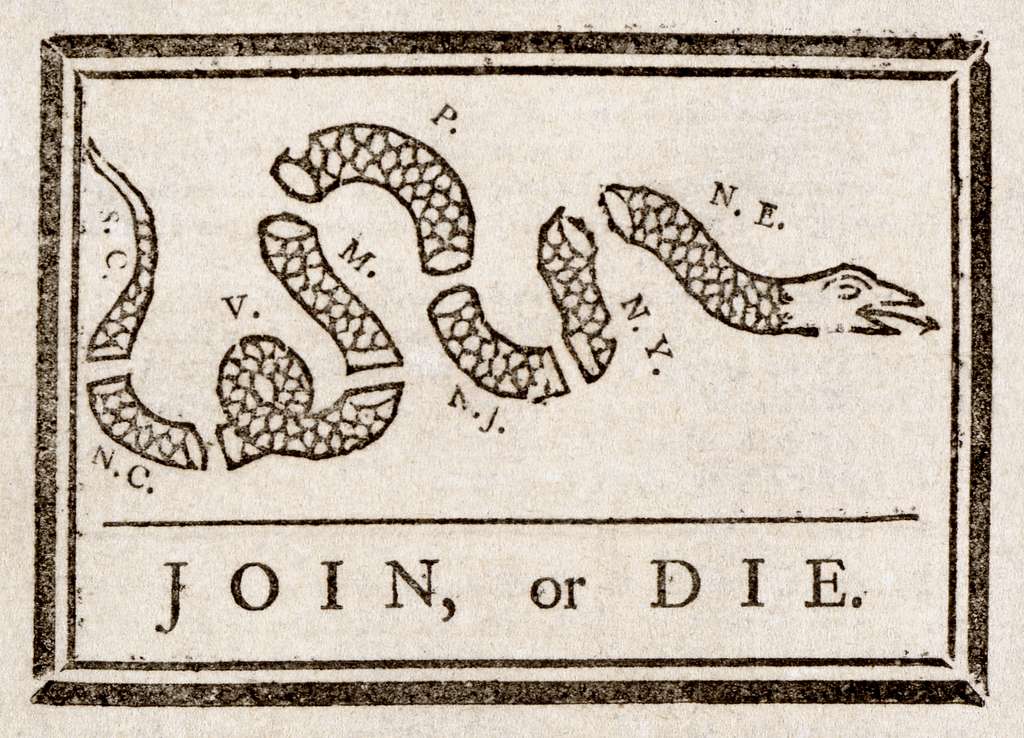
Join or Die woodcut illustration of a snake segmented into eight pieces. Public domain image from the Library of Congress.
There was an informal Q&A driven by the audience after the screening, and though the presenter (a local radio host) did a fine job of fielding queries, it seemed to me as if most in attendance left still scratching their heads about concrete next steps to improve social capital in their own towns and organizations. The importance of media like Join or Die lies primarily in its ability to raise awareness and motivate people into action, but the real work of rebuilding social trust is local, granular, and often very slow-moving. The film left me wrestling with these questions:
What local public policy levers can be pulled right now to improve social trust in my community? What are the longer-term strategies that can be pursued to the same end?
How can technology be used to improve social trust rather than degrade it?
How can communities work to develop cross-cutting social opportunities that convene people of different political, religious, economic, and cultural backgrounds?
Are there hybrid engagement models that could be effective in reaching people who currently do not participate richly in civic life?
What sort of club or organization is sustainable in my community today, and how can I help to build it?
Franklin's reptilian metaphor remains apt: the American political experiment has shown itself to be more fragile than many might have hoped, and our people are still strewn in disjointed segments when we could be moving as one toward shared purpose. It remains to be seen whether "Join or Die" is the appropriate rallying cry for our times; many who need desperately to be re-engaged in civic life are sensitive to the implications of authoritarian rhetoric and heavy-handed social engineering, and the digital technologies that have come to dominate our public discourse are often more adept at driving people apart than bringing them together. The challenge is daunting, and the stakes could not be higher.
Will we join, or will we die?