The Most Hazardous and Dangerous and Greatest Adventure
An ode to the Fisher Space Pen.
By: Chelsea Adams
Astronauts were kind of a thing for school kids in my hometown. We had a claim to fame: John and Annie Glenn had grown up and attended college in our little village. I graduated from John Glenn High School on John Glenn School Road. In second grade, I got my mom’s motorcycle helmet stuck in my locker in when I used it (it had been covered in silver, glittery wrapping paper for the occasion) to dress up as Mission Specialist Sally Ride for Halloween. I went to Space Camp, twice, once in Florida before that camp closed, and once at the U.S. Space and Rocket Center in Huntsville, Alabama. I was totally insufferable about my camp experience and about how much fun I had amongst fellow nerds. All through grade school, I was the go-to spewer of space facts, the true devotee, the girl with the posters of the space shuttle on her bedroom walls, the model of the Saturn V hanging above her bed, and the glow-in-the-dark constellations taped to her ceiling. If a friend wanted to shoot off model rockets, I could be trusted to have a supply of engines and igniters for the launch.
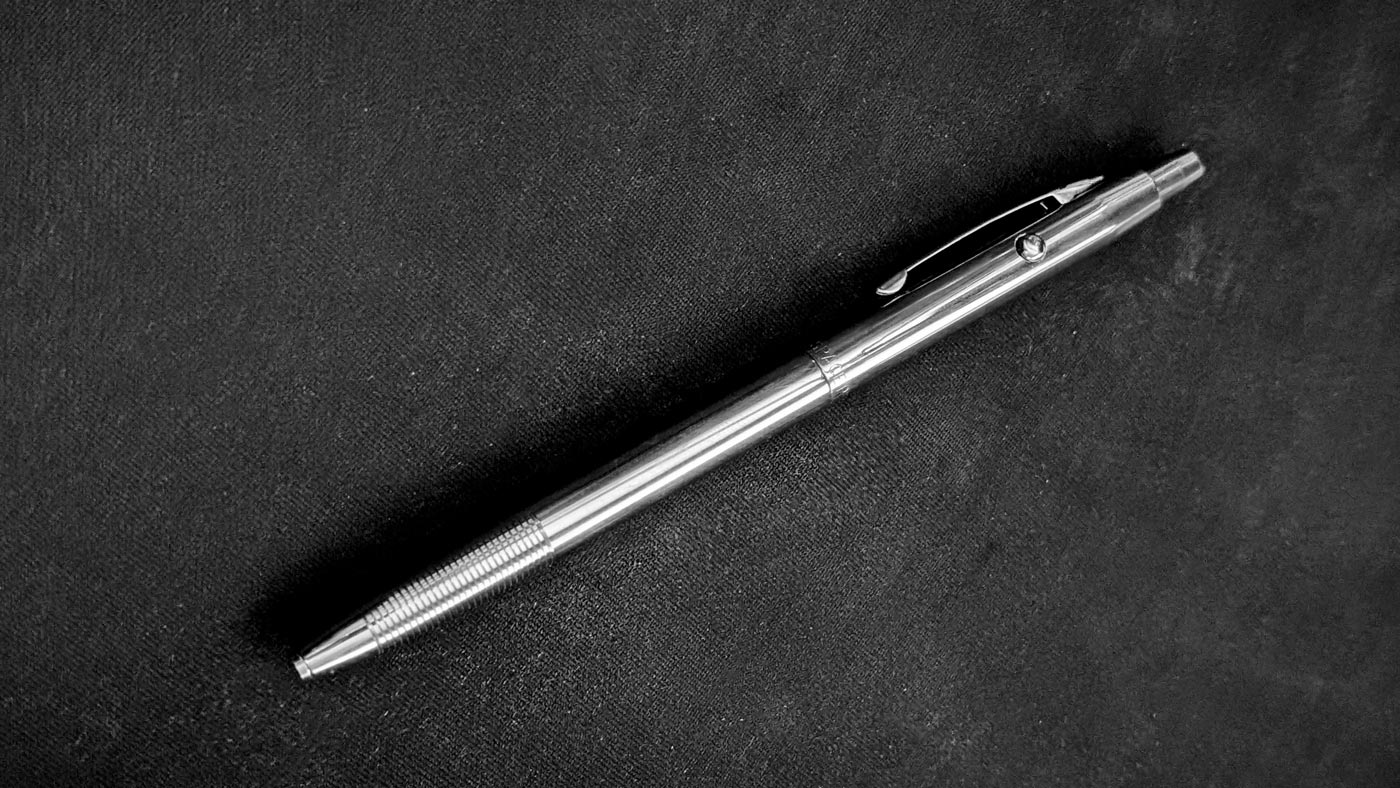
This is one of my most prized possessions, a brass and chrome-plated, 5.25” long (when open) Fisher Chrome Shuttle Space Pen. This is what I got from the gift shop on my second trip to Space Camp with my allowance money (and some generous assistance from my parents). I didn’t want the original astronaut pen; its somewhat bulkier design reminded me of the drafting pens and tools that sat on my grandfather’s desk in the basement where he kept records and artifacts of his work in electrical engineering, and it felt too big for my grip. No, I wanted the shuttle pen—weighty, sleek, and with an extra-satisfying mechanism to extend and retract the pen point (one button on the top and one on the side). Very well-balanced, somehow both lithe and substantial, a perfect fit in my hand.
This was the pen of the Space Transportation System and the International Space Station, that brand-new-at-the-time beacon of science whizzing over Earth’s continents at an orbital speed of more than 17,000 miles per hour. (Fisher Space Pens are equipped with swappable, pressurized ink cartridges capable of functioning in microgravity.) This was the pen that Sally Ride would have taken aboard the shuttle Challenger on STS-7 as she became the first American woman to fly in space. It might have been the same pen she used to sign her name to the reports she filed in accordance with her investigative duties after an explosion on that same spacecraft killed seven crew members just three years later in 1986.
I’ve swapped many new ink cartridges into this pen over the years. Excepting the slightest abrasions on the metal, the only wear that is noticeable on it after 23 years of regular use is a tiny area at the top of the clip where a few flakes of chrome plating have delaminated from regular use. This is a pen that’s written love songs, eulogies, short stories, college applications, and most of the toast I gave at my sister’s wedding. It’s what I used to sign my passport and the check I wrote when I was able to pay myself for the first time after launching my business. It’s the pen that gets me through my to do list every day, and more products ought to be made to hold up as well as this one has for decades. I’ve thrown it on the ground countless times, sent it through the wash, lost it at the bottom of backpacks and accidentally relegated it to junk drawers. It always finds its way back to my desk.
I have purchased two additional Fisher Space Pens over the years, a brass and matte black powder-coated bullet pen with a small gold shuttle decoration on the cap that I keep in my car, and the compact Backpacker pen, which comes with a keyring and the NASA logo emblazoned on the side. The Backpacker is my daily traveler, and I keep it strapped to a small all-weather steno pad that lives in my front pants pocket. Each of these implements is an artifact designed to be passed down to the next generation. They're some of the best writing implements I've used, and barring some unfortunate circumstance, I intend to keep recording my life's most important moments with them.
(Fisher didn't pay me to write this. I just really like the pens.)